Postprocessing overview
Building Blocks sources are post-processed using a workflow package maintained by the OGC. You may modify this if needed to perform additional actions - however this is subject to continual improvement as new types of building blocks are supported and improvements in available tools are made.
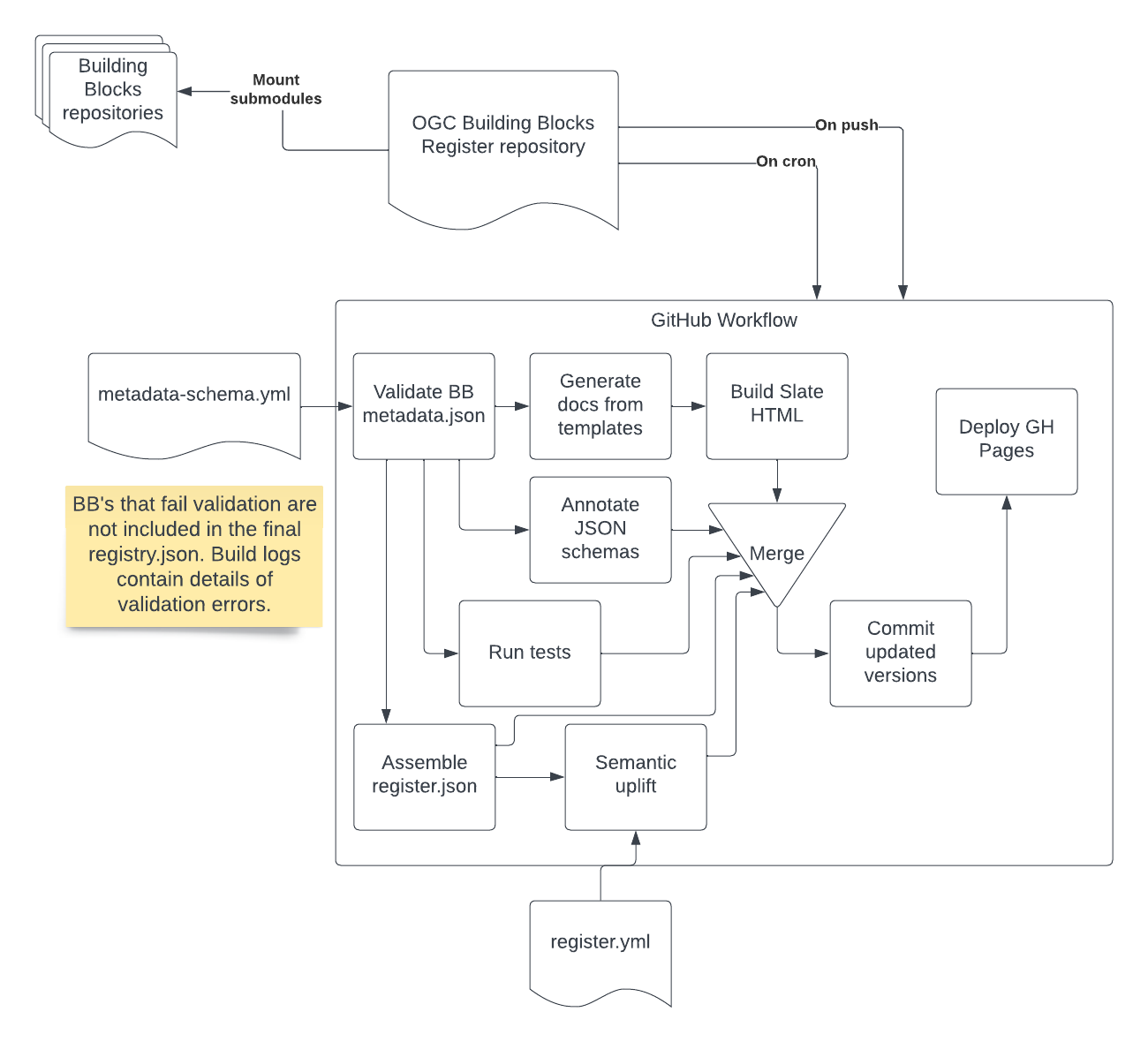
Output testing
The outputs can be generated locally by running the following:
# Process building blocks
docker run -it --pull=always --rm --workdir /workspace -v "$(pwd):/workspace" \
  ghcr.io/opengeospatial/bblocks-postprocess  --clean true --base-url http://localhost:9090/register/
Notes:
- Docker must be installed locally for the above commands to run
- The syntax for
-v "$(pwd):/workspace"may vary depending on your operating system - Output files will be created under
build-local(not tracked by git by default) - The value for
--base-urlwill be used to generate the public URLs (schemas, documentation, etc.). In this case, we use the localhttp://localhost:9090/register/URL to make the output compatible with the viewer when running locally (see below). If omitted, the value will be autodetected from the repository metadata.
Building Blocks Viewer
You can also preview what the output will look like inside the Building Blocks Viewer application:
docker run --rm --pull=always -v "$(pwd):/register" -p 9090:9090 ghcr.io/ogcincubator/bblocks-viewer
Notes:
- Make sure to compile the register before running the viewer (or delete
build-localaltogether to view the current build insidebuild). - Docker must be installed locally for the above commands to run
- The syntax for
-v "$(pwd):/register"may vary depending on your operating system -p 9090:9090will publish the Viewer on port 9090 on your machine- By default the viewer shows only local building blocks. To also show imported ones, set
viewer.show-imported-depthinbblocks-config.yaml. - A register can add custom visualizations for examples/transform outputs via view plugins, or a whole new top-level bblock detail tab via tab plugins.
Using the development build
The postprocessor’s develop branch and Docker image carry work that hasn’t shipped in a stable
v1.*.* release yet. Register maintainers who want to try an upcoming feature — or who are asked
to help test one before it’s released — can opt into it explicitly, per run or per workflow.
develop is the absolute bleeding edge: unlike the release-tagged image (the untagged/latest/v1
image used by default), @develop/:develop is a moving pointer, not a fixed version — it can pick
up new, experimental, potentially breaking behavior on every run, with no compatibility guarantee
and no notice. Use it to test something specific, then switch back — don’t leave a real register
pinned to it.
Locally, every register scaffolded from the template already has a build-devel.sh script
alongside build.sh/view.sh — run it instead of build.sh to build against the develop image:
./build-devel.sh
Any extra arguments are passed straight through to the postprocessor, so it composes with the usual flags for finer-grained iteration, e.g.:
./build-devel.sh --filter ogc.my.namespace.myblock --steps annotate,jsonld,tests
In CI, point your .github/workflows/process-bblocks.yml caller at @develop instead of @master:
jobs:
  validate-and-process:
    uses: opengeospatial/bblocks-postprocess/.github/workflows/validate-and-process.yml@develop
    secrets:
      sparql_username: $
      sparql_password: $
No other change is needed — on develop, validate-and-process.yml resolves against develop’s own
postprocessing action and Docker image automatically. The same applies to a PR-check caller workflow
(.github/workflows/pr-check.yml, if your register has one): pin it at @develop the same way to
test upcoming PR-validation behavior too.
To pin an exact image instead of following develop’s moving tip — e.g. to reproduce a bug report
against the precise image it was seen on, including a specific past v1.*.* release — pass image_tag
to validate-and-process.yml (or full/postprocess directly) without changing which ref you’re using:
    with:
      image_tag: v1.0.20   # any tag actually pushed to ghcr.io/opengeospatial/bblocks-postprocess